

Ernie McCray is (still) on the Good Foot
Catching up with poet, educator and Wildcat basketball legend Ernie McCray.

In the mid-1960s, Ernie McCray ’60 ’62 used to hang out at a hotel in San Diego where they put on talent shows. At the time, McCray was in his mid-20s, but he already felt like a much older man: three kids, a doomed marriage, joking — cynically, melodramatically — about putting a lawyer on retainer because he didn’t know what he’d do next. “That low,” he says.
One night, he decided to try some stand-up comedy. He’d never done stand-up before, but figured — why not? “A lot of people — because this was the ’60s — were trying to imitate Bob Dylan and Peter, Paul and Mary and that kind of thing,” he says. “I could sing, but I didn’t have a song prepared, so I riffed on that.” Here I am, he told them. I don’t know what the hell I’m doing here, but here I am.
Just a few years earlier, McCray had been flying through the air in Bear Down Gym, a record-breaking center for the University of Arizona Wildcats (he still holds the single-game scoring record for his 46 points against Cal State Los Angeles in 1960), the first Black basketball player to graduate from the U of A.
On the court he was a star; after the game, he was just another Black man in segregated America, practically having to press his mouth to the metal on “colored” water fountains because the pressure was so weak, barred from restaurants downtown no matter how many points he scored.

It’s the little things you remember — the water fountains. He’d seen them traveling through the South to visit family. “I’d look over at the ‘white’ water fountain, and the water would just be gushing like a geyser. And the one we drank out of, you pretty much had to French kiss,” he says. “To a kid, you just don’t have any understanding. I remember asking my mother, I said, ‘Why do people hate us?’” Her answer was unsatisfying and true: “‘That’s just the way some people are.’”
The prize for the talent show was $25 — a pretty good chunk of money in the ’60s, especially for a schoolteacher like McCray. He won. His off-the-cuff, totally unplanned stand-up routine conjured out of the depths of his desperation. “It was such a good feeling, because my life was just tragic at that point,” he says. Him and his wife, fighting all the time (“two fools”), his kids caught in the middle. “That feeling kept me alive,” he says. “That and my kids.”
The question is, would you have been able to do the same? To go up in front of a roomful of strangers at your lowest point and make them laugh? Would you have the strength to laugh yourself?
Ernie McCray is 88: the number of keys on a piano, the number of constellations in the sky. He doesn’t move like he used to — these days it’s enough just getting out of his chair.
As a kid growing up in the Dunbar neighborhood just west of the U of A campus, he used to visit his neighbor, an older woman, to write poems and stories on her typewriter. “I just thought that was the most exciting thing in the world,” he says. “To be able to write something down and have somebody read it.”
“‘You’re so smart,’” the woman would say, patting him on the head. “You’re like Langston Hughes,” and he’d walk out filled with ice cream and Kool-Aid, feeling great about himself. Ernie McCray never bought into the idea of being less than; for a long time, he didn’t even realize his school — the Dunbar School, on Second Street and 11th Avenue; the building is still there — was segregated. “I’ve been loved,” he says. “And when you’re loved, you can take all that crap.”

Photo: Arizona Athletics
The writing is almost constant now: poems, essays, reflections on current events, little bits of life mustered into words, published on San Diego-area blogs and community websites. Yes, writing is the new thing now, or the old thing in a new light (because the light is always changing) — a thread that has run through his life from childhood to 88.
He remembers interviewing for a job as a principal, at the John Muir Alternative School in San Diego. The interview panel was made up of both kids and adults — that’s how the school was run, with a sense of equity. One of the students asked: “What if you were out on the playground and saw a kindergarten kid crying in the sandbox?” McCray said he’d sit down in the sandbox and see what’s going on — how else could you find out what was happening in the sandbox? “And those kids were leaning forward,” he says. They weren’t used to adults getting in the sandbox like that, but he was right: How else could he know?
So, there’s the writing, there’s a little light exercise, there’s listening to music on his Alexa speaker (she responds in the background when he mentions her name). “I’ll beat on my bongos every now and then,” he says. “But lately, it kind of tightens my upper back, so I don’t do that as much as I used to. And I argue with the dog you just heard barking,” he says. “Nacho. He’s an órale kind of dude.”
Órale, meaning something like hey! but also OK! or right on! or sounds good! or just cool. McCray recently published a poem for his current wife, Maria — OK, they’re not married, but they call each other husband and wife, who’s counting? — that used the word as a kind of guiding principle: “An ‘Órale’ to Maria Nieto Señour, My Querida.” He wrote it on the occasion of Señour winning an award from the California Association of Latino Community College Trustees and Administrators for her 35 years of service to the San Diego Community College District. Señour has been trying to get McCray to go to bed earlier. “She’s, like, a nine-o’clock-go-to-bed-type person,” he says. Too early for him. He’s got writing to do!
McCray used to practice on the court behind the Dunbar School, running drills, taking shots and hustling for his own rebound, going up against that invisible player in his head. One-on-none, he called it. “Then I’d go home and shower off, and all was right with the world.”
“Let’s put it this way,” he says later. “I like me. I’m the best company I’ve ever had.” The blank page, the empty court, him and his imagination, his soul.
He developed his style from his friend Albert Neely, who played at Phoenix Union High School before going on to Arizona State University. “He had this gliding kind of thing,” McCray says. “I was always smooth, but I took it to another level, patterning my game after him. I thought it gave me a little edge.” He’d watch the other players on the court, hustling all over the place, swinging their elbows and blowing their energy for nothing. “And I’m just gliding, like it doesn’t matter to me at all.”

Photo: Arizona Athletics
His mother, Mary, had graduated from the prestigious, historically Black Howard University in Washington, D.C., before coming to Tucson for her respiratory issues stemming from tuberculosis. She hustled as a janitor and an Avon lady and a haircutter before finding a stable job at the telephone company when McCray was in his teens. Mary, who brought Ernie to lectures and forums and concerts on campus, to see Eleanor Roosevelt and Martin Luther King; who wanted him to understand and maybe even try and change America, not just live in it; who treated him as though he was a person of substance and worth, whose voice mattered, Jim Crow be damned — that gliding drove her crazy. “That’s kind of my personality,” he says. “She was more Type A.” McCray says she was one of the most amazing people he ever knew.
As a teenager, he loved getting Jet magazine. The pop stars, the Civil Rights coverage, the big and small of Black life in postwar America: Jet covered it all with a breadth and generosity other magazines didn’t. Like Black life was like white life: a full experience, not just some niche thing.
He especially looked forward to what they called the Beauty of the Week, a centerfold-type series that took ordinary, working Black women — not movie stars or models — and presented them almost like pinups. Now this was important. (Really, it was: You didn’t see ordinary women, especially ordinary Black women, presented this way anywhere else. Black was beautiful: That was the lesson.)
In late 1955, McCray was eagerly flipping through the latest issue of Jet and found a very different kind of image: the body of Emmett Till, the 14-year-old Black boy beaten to death, lynched and mutilated by three white men in Mississippi who claimed he had flirted with a white woman.
“Something went to the hate in me,” McCray says. He remembers walking around downtown Tucson, about to pop. “I was behind this white woman at Congress and Stone,” he says. “And I’m behind her, and she’s not paying any attention to me, and I’m just hating her.” McCray was 17 — just a few years older than Till. Was this how the world saw him — a threat, even as a kid? Was this what justice meant?
Then the light turned green and the woman crossed the street and all that hatred and balled-up anger he felt just evaporated. That woman wasn’t paying attention to him — she didn’t even know he existed. All those people out there throwing elbows, wasting energy, thrashing around in the pointless drama of their inner lives: Life was already hard enough. Why not glide?
McCray had a student during his years as a principal named Chaka. One day, Chaka got into an argument with a teacher and called her a name that got him sent to McCray’s office. It wasn’t the first time McCray and Chaka had talked — once, McCray had taken Chaka home after another bad day. “And I went into the house, and there was a closet door that was kind of open,” he says. “There must’ve been about 10 AKs in there” — assault rifles. “His parents were both gangsters. I mean, serious gangsters.” That was home for Chaka.
Now Chaka was in McCray’s office, trying to explain himself. “I believed him,” McCray says. “[The teacher] had him backed up against a wall, and Chaka was just one of those kids that wasn’t going to take that stuff. She’d disrespected him.” The name Chaka had gotten thrown out of class for calling the teacher — McCray was saying it in his head.

McCray had had a politically active young life. He’d canvassed for campaigns with his mother and helped set up get-out-the-vote barbecues. He remembers gathering in neighbors’ backyards to hear candidates running for local office — sheriff, for example — explain where they were coming from: a conversation of special importance for Black residents wondering whether this guy was going to treat them like human beings. Later, he worked with a group on campus called Students for Equality to try to raise awareness about the racial and economic injustices perpetuated by local Jim Crow laws, including housing covenants, often taking the conversation to city council meetings. Yes, life was unfair — but it was definitely fairer to some than others.
“‘Isn’t that Ernie McCray over there?’” he remembers people saying when they saw him at protests back in his U of A days. “‘I can’t believe he’d do something like that.’ Like I wasn’t human and didn’t care.”
People are always talking about how hard teaching is, he says: getting on kids’ levels, understanding what’s really going on in the sandbox, opening yourself up to the raw nerves around justice and compassion. “It’s the easiest damn thing I’ve ever done in my life,” he says. “But that doesn’t mean there isn’t work to it.” McCray gave Chaka a suspension — he had to. But he also got where Chaka was coming from.
His favorite age, by the way, is 8: that sweet spot between being too young to know much and too old and cool to be caught dead knowing it. You talk to a room full of 8-year-olds and say, “Who wants to …,” and you don’t even get to finish the sentence before hands start going up. The ideas are good, too: lucid, innovative, genuine. An 8-year-old won’t BS you, he says — we could all use a little more of that. “I’ve tried being an adult a couple of times in my life,” he says. “And I end up thinking, ‘Oh, this is not working.’”
Somewhere deep in McKale Center is a folder in a filing cabinet labeled ERNIE MCCRAY. In that folder is a partial paper trail of McCray’s Wildcat life: typed-up pages of statistics, Xeroxed, annotated and Xeroxed again; black-and-white photos of McCray with the photography studio’s stamp on the back (some by legendary Tucson photographer Jack Sheaffer); a draft of former U of A basketball player Allan Stanton’s remarks inducting Ernie McCray into the Arizona Sports Hall of Fame. (Stanton did the honors at McCray’s request, which came in the form of a handwritten letter, also in the folder, in which McCray describes Stanton as “an all-time athletic great who played in the 1700s” in big, loopy cursive letters — you can almost feel McCray laughing through the pen.)
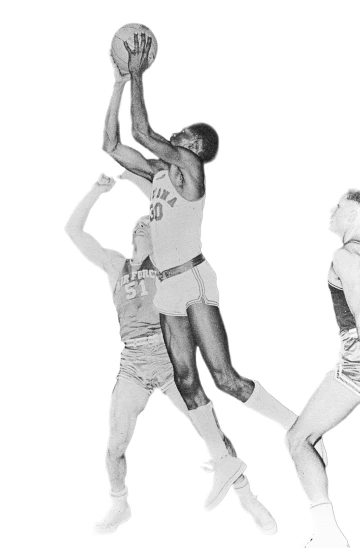
Photo: Arizona Athletics
Then there’s a single-page essay written by McCray in an earlier incarnation of this magazine from the spring of 1989. It starts with the basics: born in Tucson, Wildcat from childhood, experiences with segregation, the joy he felt as a kid running around on campus. Then it turns, slightly. “I love the University of Arizona,” he writes. “Yet there were times — as happens in all love affairs — when I could have taken that institution by the neck. I expected much more than it could give.”
He describes the political science class where a professor told him the problems he and his fellow activists faced attempting to fight discriminatory practices in Tucson weren’t worthy of discussion, and the class where South Africa came up, but nobody was willing to discuss apartheid. “As a child, I loved the school blindly,” he writes. “But as a young adult I found it reflected the times.”
Times changed. “The Tucson I visit today is refreshing,” he writes toward the end. “Stores where blacks once could only work as janitors now have black managers. When I stop by campus, I see more young black men and women than in the late ’50s. I see black cheerleaders. There were none in my day. I see black athletes utilizing their skills as a means to an education.” He calls the U of A “an institution that represents hope.”
“You know, after the ’60s, the Civil Rights Movement, the ’70s and ’80s came along,” he says here in 2026. “I knew there were racists out and about, but they were quiet, and that was so nice. I mean, I felt that viscerally, you know? The quietness.” He has more than usual to write about lately on that front: more poems, more stories, more reflections on the past, which always turns out to be closer than we think.
Ernie McCray is 88. He is old enough to have played in Bear Down Gym (no air conditioning) and to have grown up watching Linc Richmond ’49 (who had the Wildcat career scoring record until McCray beat it in 1960) and Roger Johnson ’52 when Johnson was the basketball captain one season and an All-America baseball pick the next. McCray recently saw a picture of himself as a much younger man, flying through the air with a basketball in his hand, and thought that couldn’t be me. He just couldn’t prove that he — the person he is inside, that kernel of him that has gone unchanged over all this time, that Little Langston Hughes playing one-on-none at the typewriter, first in Dunbar, then in San Diego, as a schoolteacher then a principal, a father then a grandfather — could still jump like that.
It’s early afternoon. A canvasser comes to the door asking if McCray knows about a proposition currently on the ballot in California. McCray not only knows about it — he’s already voted. There is a brief, energetic discussion. The canvasser and McCray thank each other, and McCray makes his way back to his chair. There’s a game on tonight, and he’s excited. “This team — I’ve never seen an Arizona basketball team that looks as good as these guys do,” he says — and this was in November, before the streak record, before the AP polls, before the Final Four. “They just seem to click.”
You’d think that someone so invested in Tucson — so inextricably linked to its history and changes — would’ve stayed, or at least come back, but McCray is one of those people who for whatever mystical reason loves the ocean. He can’t leave it. “If you’ve ever lived by an ocean, it’s just — it’s almost unexplainable,” he says, his voice getting lighter and dreamier, his pauses longer. “You’re at the edge of a continent!” Órale.


