

Hoops and Stars Align
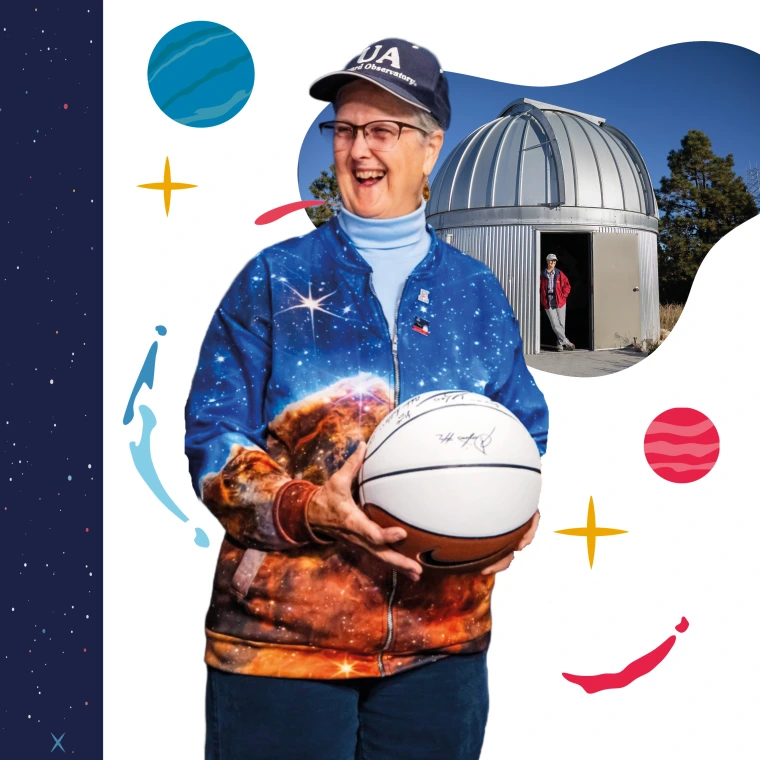
From the basketball court to the forefront of infrared astronomy, Marcia Rieke’s journey has bridged sports and astronomy.
Pandora is the first on-orbit NASA mission to be managed from the Multi-Mission Operation Center, or MMOC, marking a milestone in the U of A’s decades-long history in space research and exploration.
From the basketball court to the forefront of infrared astronomy, Marcia Rieke’s journey has bridged sports and astronomy.
Before Marcia Rieke embarked on a path that would lead her to help launch an entirely new field of scientific discovery — infrared astronomy — she hit the gym daily, chasing passes and scoring baskets.
“Before I had my career in astronomy, I played basketball in college, and that experience shaped me in lasting ways,” says Rieke, a Regents Professor in the University of Arizona’s Steward Observatory. “Being part of a team taught me discipline, resilience and the importance of showing up every day prepared to do your best. Those lessons stayed with me as I moved into science and research.”
Since joining the U of A in 1976, Rieke has made seminal contributions to infrared astronomy that have shaped the field. Her work spans astronomical research, instrument development and service to the astronomy community through public policy and outreach — achievements that have earned her international recognition.
On Feb. 9, recognizing her accomplishments in both unraveling the mysteries of the deep cosmos and excelling on the court as an undergraduate, Rieke was named the U of A’s Faculty of the Year award honoree by the Big 12 Conference.

Her most visible achievement is her role as principal investigator on NIRCam — the Near Infrared Camera, a key instrument aboard the James Webb Space Telescope. Since the telescope began scientific operations, NIRCam has both reinforced and challenged our understanding of the early universe, delivering stunning images and groundbreaking data that have captivated scientists and the public alike.
To Rieke, the connection between sports and research is an obvious one.
“When people say I’m a principal investigator, what that really means is that I lead a team,” she says. “In that role, I have to be like the coach: I have to figure out which team member is best for which job — it’s very much like the athletic enterprise.”
And scientific discovery, similarly, is a team effort. Building instruments, conducting research and making discoveries require collaboration, persistence and trust among many people over long periods.
Rieke’s work has focused on understanding the universe through infrared astronomy and on developing instruments that let us see what was previously invisible. Leading the charge in designing the NIRCam instrument from the ground up reflects decades of collaboration involving scientists, engineers, students and partners around the world, she says.
“Leveraging our longstanding experience in infrared astronomy, we succeeded with our proposal to build NIRCam,” Rieke says. “We had good ideas that helped us win over competing proposals.”
Universities like the U of A make this work possible by supporting long-term discovery and by engaging students directly in research, Rieke adds, noting that mentoring and working alongside students have been some of the most meaningful parts of her career.
“The U of A has always been very supportive, and the fact that I’ve been here for 50 years is a clue that this university has been a fantastic place to pursue research,” she says.
And basketball? Rieke says her passion for the sport has stuck with her throughout her career, and she tries to catch a game whenever her schedule allows.


